Those thin, web-like red, blue, or purple lines creeping across your legs or face aren’t just a cosmetic nuisance — they’re often the first visible sign that your veins need a little extra attention. Known medically as telangiectasias, spider veins affect at least one in three women and a smaller percentage of men, and while they rarely cause physical pain, they can take a real toll on confidence. The good news? Modern spider vein treatment is fast, minimally invasive, and remarkably effective when performed by the right specialist.
At Chesapeake Vein Center & MedSpa, your care is guided by Dr. Surya Challa, MD — a board-certified general surgeon, diplomate of the American Board of Phlebology, and Registered Phlebology Sonographer (RPhS) with nearly two decades of vein-focused experience serving Chesapeake, Virginia Beach, and Norfolk. Unlike many medical spas that are merely “associated” with an off-site medical director, Dr. Challa personally evaluates and treats every patient in our practice. He has been recognized in the Guide to America’s Top Surgeons and Strathmore’s Who’s Who Worldwide Honors, and is a Fellow of the American College of Surgeons — credentials that give our patients confidence their veins are in the most qualified hands in Hampton Roads.
What Are Spider Veins?
Spider veins are tiny, widened blood vessels that become noticeable through the skin. They may form delicate lines, branching networks, or clusters of color that contrast with the surrounding complexion. Depending on the vessel and its location, these markings can appear reddish, bluish, or violet.
You might notice them around your ankles, across your thighs, or on your cheeks and nose. Unlike larger varicose veins, spider veins generally remain flat rather than creating raised contours beneath the skin.
Although their appearance can be frustrating, spider veins do not automatically indicate a serious circulation problem. Some develop independently, while others occur alongside changes in nearby veins. A professional evaluation can help determine whether treatment should focus on the visible vessels alone or address an underlying source.
What Causes Spider Veins?
Several influences can contribute to the development of visible surface vessels. Some affect the structure of small blood vessels, while others change the pressure within the veins of your legs.
Factors that may contribute include:
- Family history of visible veins or circulation problems
- Hormonal fluctuations, including changes during pregnancy
- Increasing age and changes in blood vessel elasticity
- Long periods of standing, which can increase pressure in leg veins
- Excess body weight, which may place additional demands on circulation
- Repeated sun exposure, particularly when spider veins appear on the face
- Previous skin injuries or localized inflammation
In some patients, malfunctioning veins beneath the surface contribute to the development or persistence of spider veins. However, not every case involves venous reflux.
Maintaining an active lifestyle, avoiding prolonged inactivity, and protecting your skin from excessive sunlight may help support vein and skin health. These measures cannot guarantee that new spider veins will not develop.
How Are Spider Veins Diagnosed?
Evaluating spider veins begins with examining where the vessels appear, how extensively they have developed, and whether you have additional symptoms.
Dr. Challa can assess the visible vessels and ask about concerns such as leg heaviness, swelling, or a history of varicose veins. These details help distinguish isolated surface changes from symptoms that may warrant further investigation.
If an underlying circulation problem is suspected, duplex ultrasound may be recommended to evaluate blood flow in deeper or larger superficial veins. This examination is not necessary for every patient with spider veins.
By identifying the vessels involved and determining whether other vein conditions are present, Dr. Challa can recommend an appropriate treatment strategy.
Spider Vein Treatment Options
Spider vein treatments are non-invasive or minimally invasive and include sclerotherapy and laser procedures. Because they are considered cosmetic, they are typically not covered by health insurance or Medicare unless a more serious underlying condition is diagnosed. Dr. Challa uses the fiberoptic Veinlite — the gold standard for mapping superficial varicose veins and feeder vein networks — along with magnification and specialized light filters to improve accuracy during every injection. With a bright 150-watt light source and unique ring-light design, the Veinlite images veins deeper and over a wider field of view, helping uncover the feeder veins often responsible for stubborn telangiectasias.
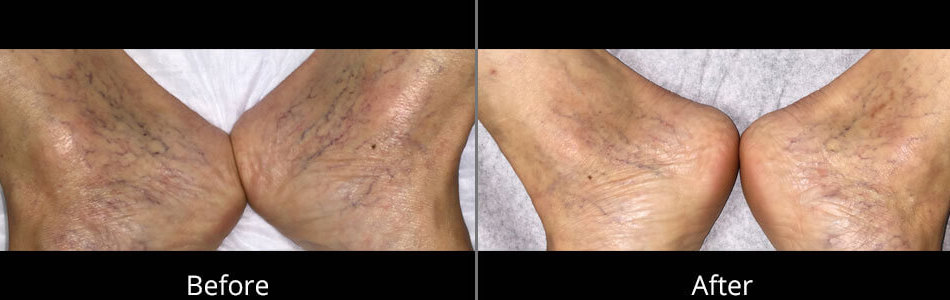
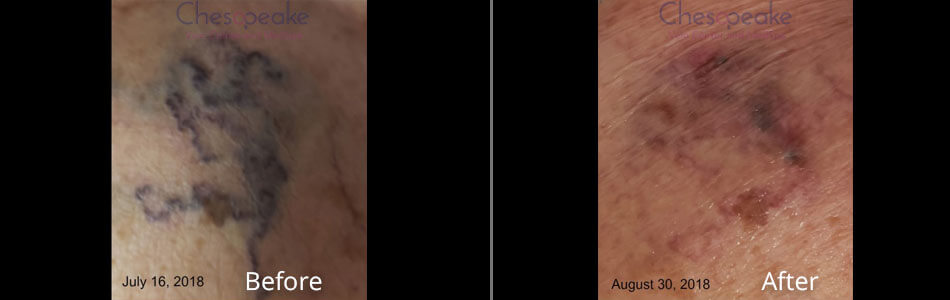
Spider Vein Treatment Before and After Photos in Chesapeake, VA
Before
After
Before
After
Before
After


Individual results may vary
Why Choose Chesapeake Vein Center & MedSpa for Spider Vein Treatment?
Established in 2007, Chesapeake Vein Center & MedSpa has become one of Hampton Roads’ most trusted destinations for vein health and aesthetic care — all under one roof. Dr. Surya Challa brings world-class surgical training from Maimonides Medical Center in Brooklyn and Memorial Sloan Kettering Cancer Center in New York, combined with deep specialization in phlebology and venous disease. As an active member of the American College of Surgeons, the American College of Phlebology, and the Medical Society of Virginia, Dr. Challa stays at the forefront of vein medicine so his patients benefit from the safest, most advanced techniques available. Every consultation, diagnosis, and treatment is delivered personally by Dr. Challa — never delegated — giving you the peace of mind that comes from being cared for by a true expert.

Schedule Your Spider Vein Consultation Today
Ready to feel confident in your skin again? Contact Chesapeake Vein Center & MedSpa today at 757-819-7633 to schedule your spider vein consultation with Dr. Challa and discover how quickly smooth, clear skin can be yours again.